Meet Me On: A Chinatown Block

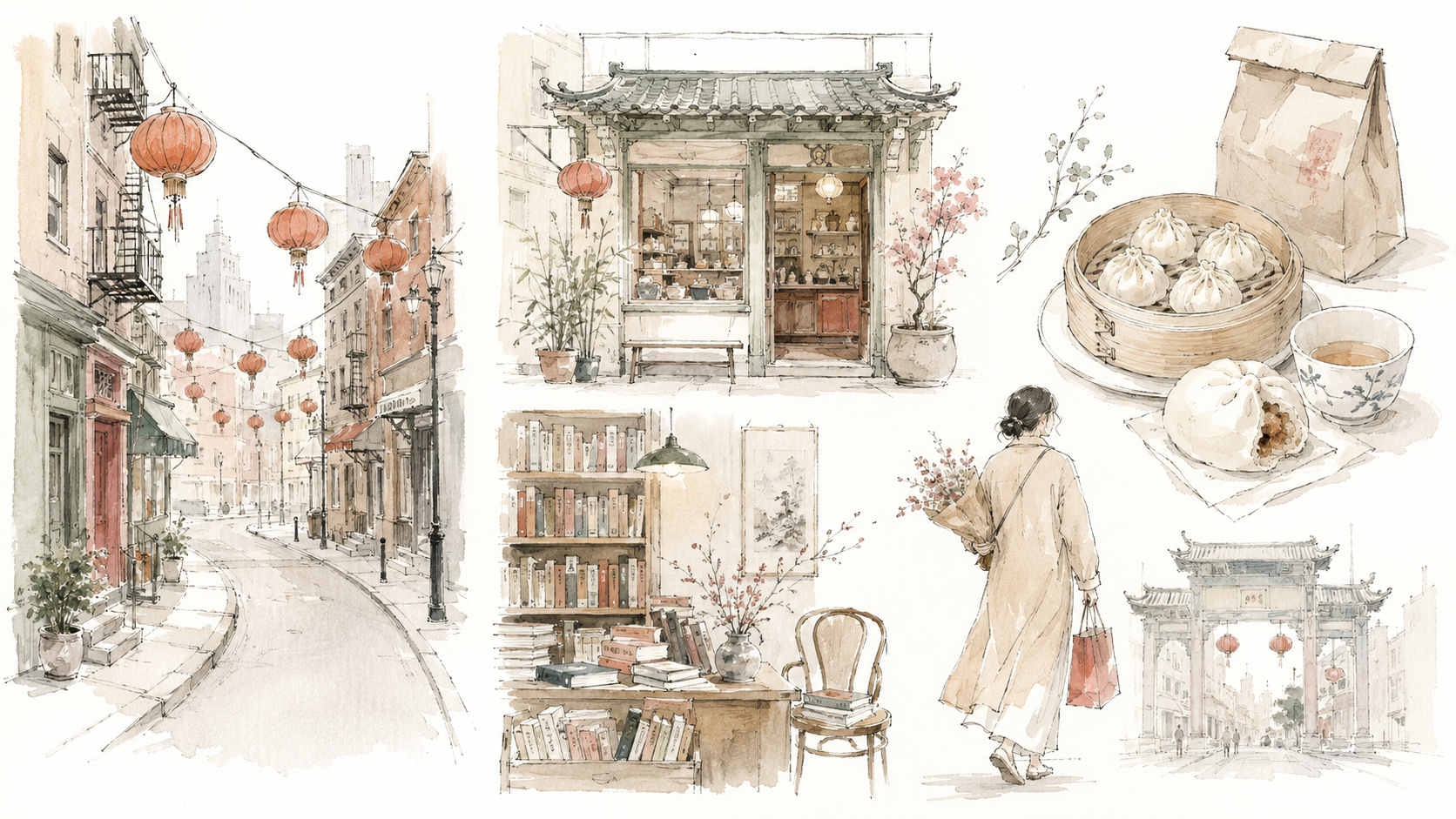
It is a neighborhood of steam rising from bakery windows, red signs, fruit stands, paper lanterns, tiled floors, family-run shops, narrow streets, hidden staircases, and conversations happening in every direction. It is old New York and living New York at the same time — layered, busy, and generous.
For Deux Pigeons, Chinatown is one of the best neighborhoods for a one-day walking itinerary because it gives you everything we love in a city day: food, history, small shops, beauty, community, and the feeling that the best discoveries are just around the corner.
This is our perfect Chinatown day — part walking tour, part food crawl.
Start at Chatham Square
Begin at Chatham Square, where so many of Chinatown’s streets seem to meet and unravel at once. From here, you can move toward Mott Street, Doyers Street, East Broadway, Worth Street, or Columbus Park.
It is a beautiful place to begin because it gives you the feeling of arrival. The neighborhood opens in all directions: markets, bakeries, restaurants, old storefronts, side streets, and signs stacked above signs.
Before choosing your first stop, take a minute to simply look around. Chinatown rewards attention.
Morning: bakeries, coffee, and something wrapped in paper
Start the day with something simple and delicious.
A Chinatown morning should involve a bakery bag, a coffee, and at least one treat you did not plan on buying. Go early, when the streets are waking up and the bakery counters are full.
A few classic morning stops:
Mei Lai Wah
Famous for its pork buns, but also perfect for that classic Chinatown bakery feeling: quick, warm, busy, and deeply satisfying.
Banh Mi Saigon
A slightly different kind of morning stop: part jewelry shop, part sandwich counter, and completely New York. Pick up a classic Vietnamese coffee made strong with condensed milk.
Deux Pigeons note: The best Chinatown breakfast is not necessarily seated. Sometimes it is a paper bag in one hand, coffee in the other, and a street corner.
Walk Mott Street
After breakfast, walk down Mott Street.
Mott Street is one of those New York streets where every storefront feels like a story. Look for produce stands, hanging signs, bakeries, small shops, and old family businesses. This is a good stretch to wander without trying too hard to “do” anything.
Stop into Wing on Wo & Co., one of the most beautiful and meaningful shops in the neighborhood. It is known for porcelain, gifts, home objects, and Chinatown history. It has the feeling of an old shop that is still very much alive — full of delicate things, useful things, and things with memory.
This is exactly the kind of place we love: a shop where objects feel connected to family, tradition, and everyday beauty.
Doyers Street: the cinematic turn
From Mott Street, turn onto Doyers Street.
Doyers is one of the most atmospheric streets in New York — curved, narrow, dramatic, and instantly recognizable. It feels like a movie set, but it is not a set. It is real, layered, and full of history. It’s where the first Chinese opera house in New York was located, which has now become Chinese Tuxedo, a wonderful restaurant keeping the history of the neighborhood alive.
Walk slowly here. Notice the bend in the street, the signs, the old facades, and the way the city suddenly feels more intimate.
This is also a lovely place for a few photos, but the better memory is the feeling: the sense of stepping into a smaller, older, more cinematic version of New York.
A tea or snack pause
By late morning, choose a small food pause.
You could stop for dumplings, tea, noodles, or something sweet. Chinatown is perfect for grazing rather than committing too early to one big meal.
Tasty Dumpling
A casual dumpling stop that works well if you want something quick and satisfying. The husband and wife team also does crafted pulled noodles made to order.
Nom Wah Tea Parlor
A historic dim sum room with vintage charm. It is more well-known now, but still worth including for its old New York atmosphere.
Taiyaki NYC
More playful take on something sweet. We love coming for the “mermaid fish” icecream cones.
Alimama Tea
A modern stop for tea, mochi doughnuts, and a lighter afternoon treat.
This is where Chinatown becomes especially fun: old-school and new-school sit side by side. You can go from a decades-old dumpling counter to a modern dessert shop within a few minutes.
Fong On
Family owned since the 1930s, this artisanal tofu shop is a great stop for something sweet or savory. A must try!
Columbus Park: the neighborhood at ease
Walk toward Columbus Park.
This is one of the most important stops in the day because it gives the itinerary a pause. Sit for a few minutes. Watch people playing cards, talking, gathering for community Tai Chi, practicing music, or simply passing through. It is one of those places where the neighborhood feels most itself.
For Deux Pigeons, this is the kind of stop that matters. A park bench can tell you as much about a neighborhood as a famous restaurant.
Lunch: noodles, roast meats, or dim sum
For lunch, choose the mood.
For old-school Chinatown:
Try Great NY Noodletown, Hop Kee, Wo Hop, or Peking Duck House.
For dim sum:
Try Nom Wah Tea Parlor, House of Joy, or Dim Sum Go Go.
For something casual and deeply satisfying:
Try Yi Ji Shi Mo for rice noodle rolls.
A Chinatown lunch does not need to be precious. It should be generous, flavorful, and maybe a little chaotic in the best way.
Afternoon: Museum at Eldridge Street
After lunch, walk to the Museum at Eldridge Street.
This is one of the most beautiful and unexpected cultural stops near Chinatown. Housed in the restored Eldridge Street Synagogue, it connects you to the immigrant history of the Lower East Side and the many communities that shaped this part of Manhattan.
It is a perfect afternoon stop because it shifts the pace of the day. After the noise and movement of the streets, the museum feels quiet, detailed, and almost jewel-like.
Look up at the windows, the patterns, the arches, and the light. It is a reminder that New York’s history is not one story, but many stories layered together.
Bookish stop: Yu & Me Books
Next, make your way to Yu & Me Books on Mulberry Street.
This is one of the most meaningful newer stops in the neighborhood: a bookstore, café, bar, and community space centered around Asian American stories and voices. It brings a beautiful literary energy to the Chinatown day.
Small shops and beautiful objects
Chinatown is full of small shops that reward slow browsing.
Ting’s Gift Shop
Tiny, old-school, and full of small treasures.
Wing on Wo & Co.
Porcelain, gifts, and objects with history.
Canal Street Market
A newer market-style stop with food and shopping, good if you want a more modern contrast.
Local kitchen supply shops
These can be some of the most interesting places to browse: bowls, tea cups, chopsticks, steamers, enamelware, utensils, and everyday objects that feel beautiful because they are useful.
Deux Pigeons note: In Chinatown, the best shopping is not about finding something expensive. It is about finding something specific — a tiny dish, a red envelope, a tea cup, a paper lantern, a packet of incense, a cookbook, a fruit you have never bought before.
Creative activity: make the day hands-on
Take a calligraphy or brush-painting class
Look for local cultural centers, art studios, or seasonal workshops connected to Chinese arts and writing.
Do a tea tasting
Visit a tea shop and ask for help choosing something. This turns shopping into a small ritual.
Take a food tour — or make your own
Choose one theme: dumplings, buns, noodles, bakeries, or tea. Try three stops and compare.
Try a photo walk
Give yourself a visual theme: red signs, tiled floors, fruit stands, old storefronts, handwritten menus, steam in windows, or beautiful shadows.
Cook from the neighborhood
Buy ingredients, sauces, tea, or snacks to bring home and build a Chinatown-inspired dinner later.
Golden hour: wander toward the Manhattan Bridge
As the day softens, wander east or south and let the neighborhood change around you.
You can walk toward the Manhattan Bridge, down East Broadway, or back through Doyers and Pell Streets. This is a good time for a final bakery stop, a small bag of fruit, or a tea for the walk.
Chinatown at golden hour is beautiful in a way that feels unpolished and alive: delivery bikes, restaurant windows, glowing signs, families heading to dinner, tourists trying to decide where to eat, regulars who already know exactly where they are going.
Old-school dinner
Chinese Tuxedo for a little history and a beautiful dining room, go next door to Apotheke for a cocktail pre or post dinner.
The best Chinatown dinner is one where the table is crowded. Order more than you think you need. Share everything.
Closing note
Chinatown is not a neighborhood to consume quickly. It is a neighborhood to return to.
It changes block by block and hour by hour: morning bakeries, lunchtime crowds, afternoon shop windows, park benches, dinner rush, neon, steam, laughter, scooters, fruit stands, and the quiet poetry of everyday life.
For Deux Pigeons, a perfect Chinatown day is not about finding the “best” version of anything. It is about following your senses. Something warm from a bakery. A turn down a narrow street. A porcelain cup. A park bench. A book by someone whose story opens a new door. A dinner table full of dishes to share.
A day in Chinatown reminds us why we love curated walking guides in the first place: they give you a path, but the neighborhood gives you the magic.