From Markets to Mangroves: A Handmade Love Letter to Cartagena
I recently returned from my second trip to Cartagena, and let me tell you: the second time around didn’t disappoint — just like the first.
But the first time I went, it wasn’t just a vacation.
It was a celebration.
I had traveled there with my dear friend, Thuy-Anh, after we thought she had beat cancer. We needed warmth — literal and emotional. We needed color after months that felt clinical and gray. We needed to escape the northern winter and remind ourselves that life could still feel vibrant again.
Cartagena was where we chose to exhale.
It was sunshine on our shoulders. Mango juice in sweating glasses. Music drifting through open windows. And everywhere we turned, artisans — woven textures, embroidered linens, hand-crocheted hammocks. We have always shared a love of discovering beautiful, handmade things. There was something healing about wandering markets instead of hospital hallways. Cartagena was just the place for that.
On that first trip, Thuy-Anh bought a piece of artwork from a local gallery — a painting of two women embracing. She looked at it and said, “This is us.” After months of medical appointments and uncertainty, choosing something handmade felt like choosing life — slow, detailed, intentional.
When she suddenly passed away, that painting passed to me. Now it hangs in my home.
Fast forward over a decade. When my friend, Moz, texted me randomly one day asking if I was up for a little adventure sans kiddos, I immediately said “YES!” We thought about a few places. Someplace warm, beautiful, and not too far were prerequisites. I immediately thought about Cartagena. It checked all the boxes.
But if I’m honest, I was hesitant to go back.
Part of me was genuinely concerned I would cry directly into an arepa de huevo — which feels deeply disrespectful to both the cornmeal and the fryer. I had this very specific fear of sitting there, mid-bite, overwhelmed by memory and grief, tears mixing with hot oil and ají.
Grief is unpredictable like that.
But there was another part of me — a louder, braver part — that didn’t want to keep me from seeing this beautiful place again. This place where I had been so happy with my friend. This place I knew I wanted to share with Moz because I was certain she would fall in love with it. And if I did cry, Moz was the kind of friend that would be there right next to me with no judgement.
And I knew, without question, that Thuy-Anh would want that for us.
She was just amazing like that.
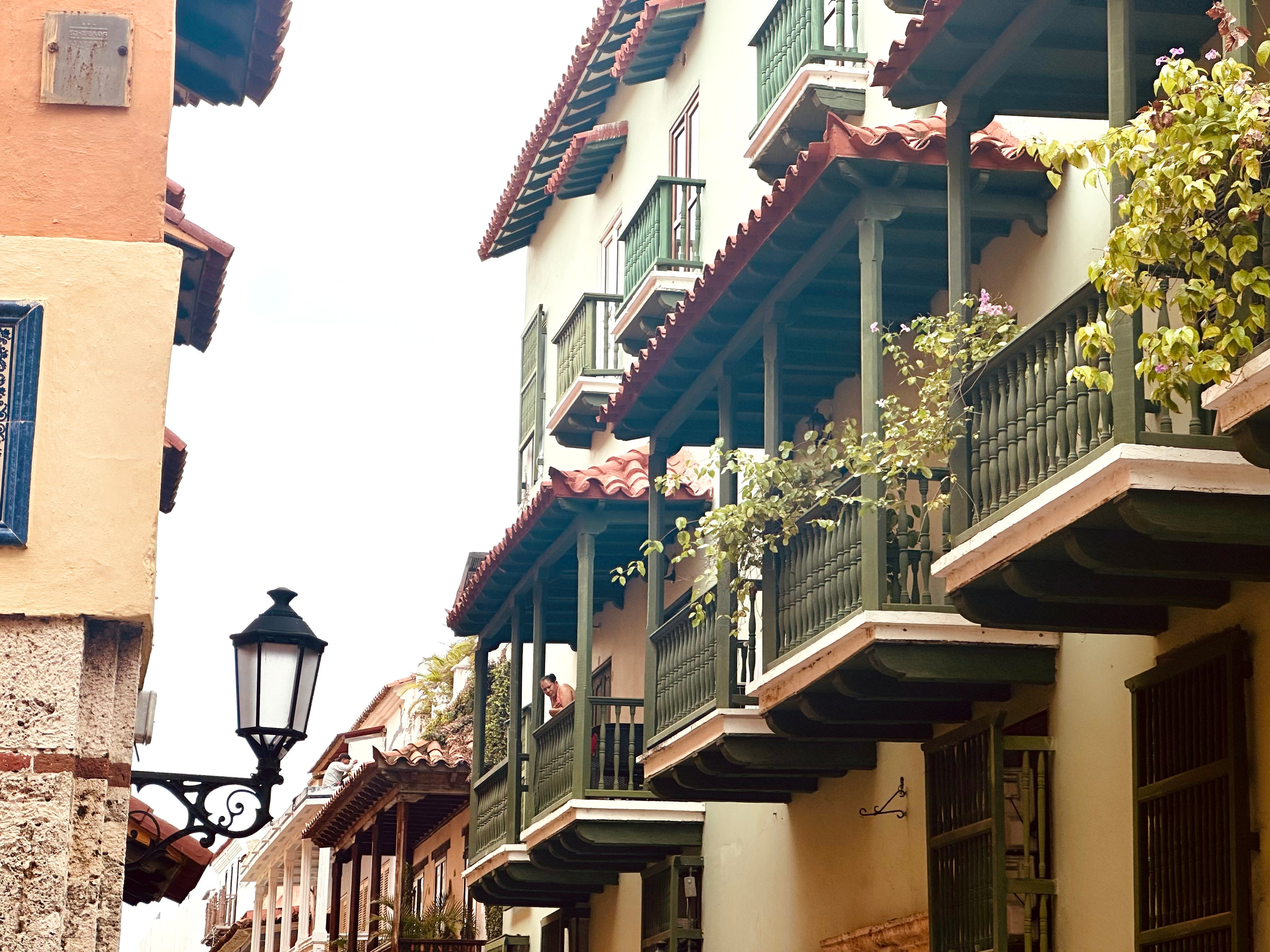
So Moz and I booked our tickets on Friday and were packed and on a plane five days later. When we landed, Moz’s jaw dropped. She looked at the city like it was a magical coloring book come to life — sun-washed walls in coral and turquoise, bougainvillea tumbling everywhere, streets so vibrant even my most tired walking shoes started humming. We are fairly certain the city runs entirely on tropical flowers and street food. It made me so happy to see Moz happy.
What struck us most is that Cartagena still feels real.
Yes, people visit. Yes, it’s beautiful. But it hasn’t tipped into that overexposed, algorithm-fueled chaos where every doorway has a line and every coffee order comes with a tripod. The streets still feel lived in. The markets still feel local. The music spilling from open windows isn’t curated — it’s just life. Although, a Four Seasons is moving in, so I have a feeling all of that may change.
We checked into our two-bedroom suite at the rustic-chic Casa San Agustín hotel, which houses a 300-year-old aqueduct. We felt like we were living out a scene in a novel. I told Moz I was ready to look up local real estate listings, buy furniture, and learn Spanish.
Cartagena doesn’t scream souvenirs. It whispers craftsmanship even in the most humble of offerings. No glittery “I ❤️ Cartagena” keychains. Instead: linen napkins with delicate embroidery, hand-crocheted hammocks perfect for mid-shopping naps, woven homeware that feels like it was patiently made — not mass-produced.
For me, traveling somewhere that values handmade goods changes everything. Shopping becomes joyful instead of transactional. Haggling over a basket feels less like bargaining and more like participating in something human. You’re not just buying an object — you’re buying hours of someone’s work, tradition, and skill.
Speaking of baskets… Moz and I stumbled upon a tiny market tucked into a square (conveniently located in front of a bar with excellent cocktails), the kind of place you only find if you close Google Maps and accept getting slight lost. There it was: tables overflowing with Wayuu mochila bags, bursting with geometric patterns and colors that could make a rainbow blush. Naturally, we fell in love and almost bought one in every color before we had to pack our bags to head back to New York. I immediately thought of Deux Pigeons, imagining how the bright colors, the geometric details, and the intricate weaving of palm leaves could inform our designs.
The next day we were off to Barú. Picture this: being whisked away in a boat to the hotel’s private island beach club with palm trees swaying, mangroves winding like a nature-made maze, and beach chairs waiting for lazing all afternoon. Our newly acquired mochila bags heroically carried sunscreen, books, and my over-ambitious notebook full of doodles. It was a quiet, dreamy day — the kind where you pretend you’re in a boutique travel magazine and pinching yourself that you get to live this life.
In Cartagena, you can spend a morning in the sun, salty and barefoot, and by afternoon you’re wandering cobblestone streets, admiring colonial architecture, discovering tiny galleries, studying patterns carved into wooden balconies. It’s Caribbean ease layered with Latin artistry. Beach mixed with design. Music mixed with history. For travelers who need art and culture woven into their sunshine, it’s ideal.We couldn’t go to Cartagena without visiting Club Havana, or any place with live music and dancing.
The rain was falling outside, warm and dramatic, soaking the streets. Inside, everyone danced anyway. No hesitation. No self-consciousness. Just music, movement, laughter. Strangers spinning across the floor like they come every night.
Life was to be lived.
I remember looking over at Moz — laughing mid-spin — and feeling overwhelmingly lucky.
Lucky to have a friend like Moz to dance through life together. Lucky to have known Thuy-Anh.
Lucky to have women in my life who show me, again and again, how to live joyfully.
Now, whenever I toss my phone into that bag this summer, I’ll be transported back to Cartagena with my lovely friend: letting our dance moves run wild in the rain (because apparently every good story involves a little water), our quiet evening chats in one of many amazing restaurants, trying to give ourselves hotel room pedicures, and the salty breeze while having mojitos on our last night. That bag isn’t just a souvenir; it’s a portable memory capsule.
The painting of the two women embracing hangs quietly in my home. I see it almost every day. And when I do, I’m reminded not only of Thuy-Anh — but of what she would want for me.
She would want me to return.
She would want me to laugh.
She would absolutely want me to share Cartagena — and to order the arepa without fear of tears and to buy that ridiculously expensive thing because it’s just so cool (another story).
Cartagena isn’t just a city I love.
It’s where we celebrated survival.
It’s where I learned handmade objects can carry entire chapters of your life.
It’s where I danced and felt carefree again.
And it’s where I was reminded that joy — even when bittersweet — is still joy.
Some places and people become part of your story.
And sometimes, they hang on your wall or in your closet — reminding you to keep going.